|
|
CHARLIETM
stands for:
|

|
Combinatorial Heuristic Arrangement of Linker Elements. |
He is RACHEL's little brother, and the first add-on module.
As stated previously, RACHEL combinatorially derivatizes a lead compound site to improve receptor complementarity. In essence, she builds from a known scaffold to optimally fill a cavity-like region.
However, there are many applications in drug design that call for the generation of splicing fragments to span a region of the active site. CHARLIE is proficient in building bridges between structures and is useful when substructures that tightly bind different regions of the active site are present. CHARLIE is designed to link these complementary fragments together to generate a complete ligand.
There are two main applications for which CHARLIE is normally used.
1. Scaffold replacement: two or more portions of a single (usually flexible) ligand need to be joined using a more rigid or novel chemical scaffold.
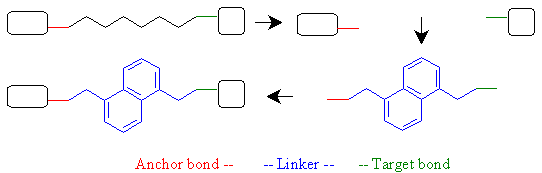
In this scenario, you might have a lead compound that contains two distinct regions that tightly complement the receptor separated by a weakly binding or highly flexible linker. Replacing the linker region with a more rigid or more complementary fragment would be highly desirable.
2. Bridge generation: two or more separate ligand fragments need to be spliced.
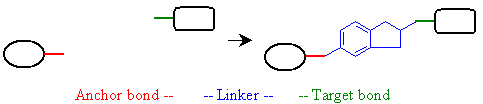
In this scenario, you might
have fragments from two or more well characterized lead compounds that
bind to separate regions of the active site. The task then
becomes one of generating appropriate linker structures to join the separate
fragments into a single compound. In doing so, we must also consider
the receptor cavity and optimize both steric and electrostatic complementarity.
CHARLIE utilizes all the numerous technical advances that RACHEL employs. In addition, CHARLIE uses a modified search engine to combinatorially add database components to the anchor bond to generate derivatives that span the active site - linking anchor bond to target bond. As such, CHARLIE links numerous database fragments together to produce complete ligands that optimally complement the active site.
To see
real-world examples of CHARLIE's utility, please click here.